Page 1 of 2
Highest note priority by Hugh Banton
Posted: Wed Mar 03, 2021 2:05 pm
by Spogg
Hugh Banton made me a highest note priority midi system. Flowstone has last note priority when 1 voice is set for mono playing.
Some real monophonic instruments feature highest note priority, so if you press 2 or more keys down together (or fret more than one position on the same string) only the highest note will sound, as is the case with some analogue synths like the Mini Moog. In FS you can play lower or higher than a held note and get the lower note sounding. This is fine in practice but it’s not authentic behaviour in some situations.
Hugh works exclusively in FS4 alphas so I converted it to FS 3.06 and share it here with his blessing.
It’s provided with a slightly modified version of the FS demo synth so you can play and test it directly. I provided a slide switch so you can choose between last note and highest note.
Mega thanks to Hugh!
Re: Highest note priority by Hugh Banton
Posted: Wed Mar 03, 2021 5:52 pm
by deraudrl
Total random curiosity: were there any old-school synths that were low-note priority?
I would think that for a mono keyboard, it would just be a matter of which direction the keys were connected or scanned...not sure there's any hardware reason to prefer high-to-low over low-to high. Although I suppose at some later point everyone is either (1) copying Moog behavior or (2) buying keyboard assemblies from the same source.
Re: Highest note priority by Hugh Banton
Posted: Wed Mar 03, 2021 5:58 pm
by deraudrl
Spogg wrote:Some real monophonic instruments feature highest note priority, so if you press 2 or more keys down together (or fret more than one position on the same string) only the highest note will sound...
Another bit of random curiosity: I understand that behavior from a stringed instrument, but not a mechanical keyboard. Do you have an example?
(I'd settle for an example of a monophonic non-electronic keyboard instrument.)
Re: Highest note priority by Hugh Banton
Posted: Wed Mar 03, 2021 6:33 pm
by tulamide
That's a good one! The code could be optimized a little bit and the seperation into two modules is unnecessary, but the code is solid and serves the purpose!
I recommend it, if that means anything

Re: Highest note priority by Hugh Banton
Posted: Wed Mar 03, 2021 9:43 pm
by martinvicanek
deraudrl wrote:I would think that for a mono keyboard, it would just be a matter of which direction the keys were connected or scanned...not sure there's any hardware reason to prefer high-to-low over low-to high.
When you look at the wiring diagram it becomes obvious why it is the way it is. Back then I modded my Moog Prodigy with its 2(!) oscillators to play the upper and the lower notes when you pressed more than one key. It sounded crappy!
Re: Highest note priority by Hugh Banton
Posted: Wed Mar 03, 2021 10:02 pm
by martinvicanek
On another note, the (monophonic) Moog had other desirable features apart from the highest note priority:
1. The envelope would not start from zero with a new note but from the value where it just was when you hit the key.
2. Same for the phase of each of the oscillators.
This way there were no clicks - something hard to achieve with FS.
(Sorry if I have drifted away from the original topic).
Re: Highest note priority by Hugh Banton
Posted: Thu Mar 04, 2021 12:03 am
by MrFuls
deraudrl wrote:Total random curiosity: were there any old-school synths that were low-note priority?
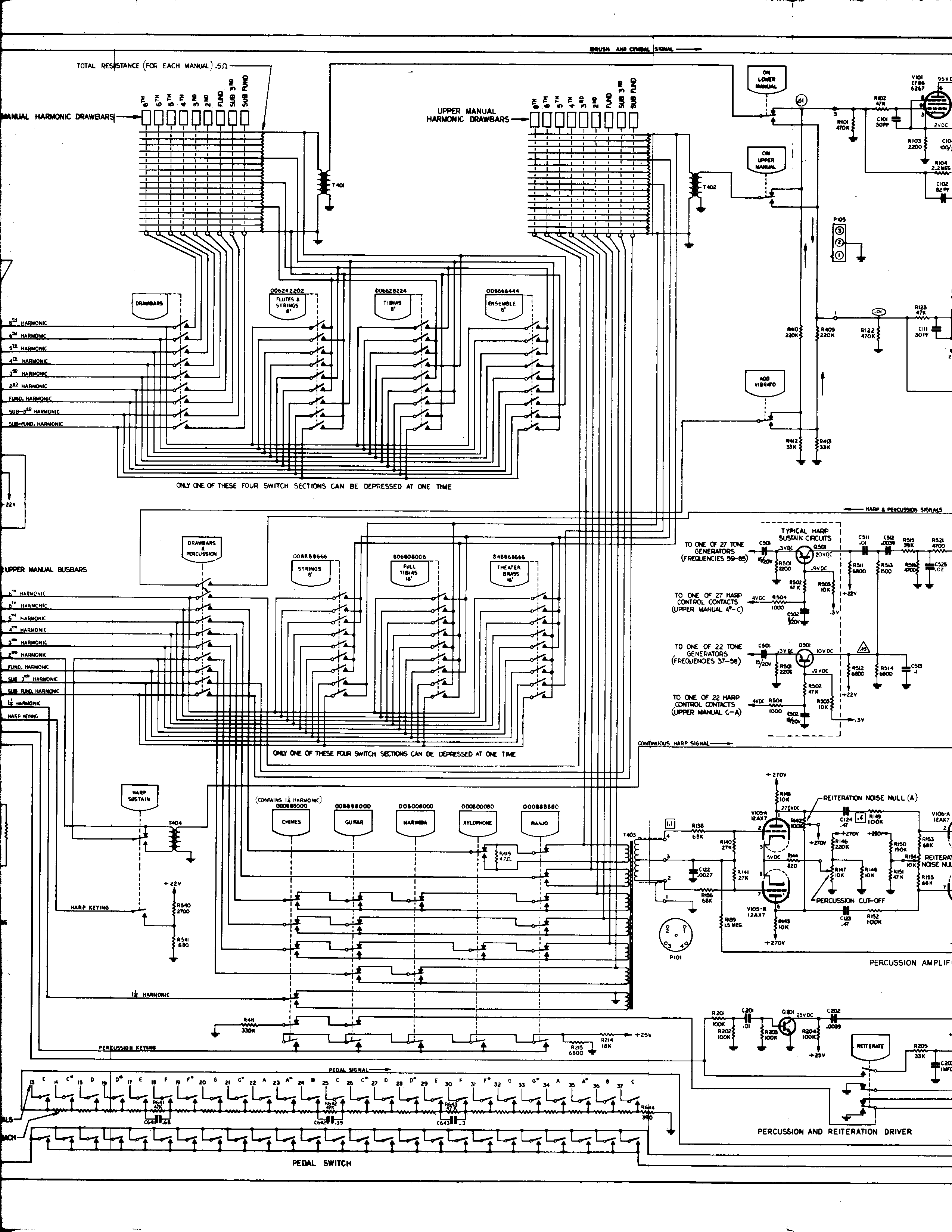
Not really a synth, but some Hammonds used a monophonic transistor frequency divider in the later days for the pedals (Hugh will be familiar I'm sure!). In lieu of providing a proper set of tonewheels for the 16ft bass octave, frequencies were tapped straight from the 8ft tonewheels, and sent down to different taps in a resistor ladder that linked each pedal contact. What determined note priority was electricity simply taking the shortest path to ground.
Low C had no resistor, while C# had 100 ohms, D 200 ohms, onward...
At least that's how I think it worked, ripped the thing out of my setup ages ago for something custom and polyphonic

Re: Highest note priority by Hugh Banton
Posted: Thu Mar 04, 2021 8:02 am
by Spogg
deraudrl wrote:Spogg wrote:Some real monophonic instruments feature highest note priority, so if you press 2 or more keys down together (or fret more than one position on the same string) only the highest note will sound...
Another bit of random curiosity: I understand that behavior from a stringed instrument, but not a mechanical keyboard. Do you have an example?
(I'd settle for an example of a monophonic non-electronic keyboard instrument.)
The real keyboard instruments that I was thinking of are those that use a fretting system for sound generation. For example a Hurdy Gurdy uses keys in a standard chromatic layout pattern which press tangents onto a string to shorten its length. I’ve come across several traditional keyboard instruments that use string fretting techniques.
I was being a bit lazy with my text because I could have said any instrument that uses fretting. Right now I can’t think of any other type of monophonic keyboard-based instrument. Of course keyed and holed wind instruments will only sound the highest note chosen because the length of the air column is reduced for higher pitches in the same way a string is shortened.
I’m sure that Hugh can chip in about low note priority for organ bass and such.
Re: Highest note priority by Hugh Banton
Posted: Thu Mar 04, 2021 11:37 am
by HughBanton
I did indeed play pedals on a Hammond E100 back in the day. Lowest note priority. But my recollection is that they simply used change-over switches forming a ladder network, like this :
Dissapointly this schematic doesn't seem to actually make any sound. Can someone show me where I've gone wrong?
H
Re: Highest note priority by Hugh Banton
Posted: Thu Mar 04, 2021 1:48 pm
by HughBanton
Except apparently I'm wrong about the Hammond - I stand corrected!
http://captain-foldback.com/Hammond_sub ... 00F29d.GIFSo I suppose the following divider circuit must have locked on to the loudest thing it could 'hear'. Unvbelievable that that worked!
Mind you, change-over contacts are going to get very iffy after a year or two living near the floor. They doubtless already knew that in Chicago c1965.
H